


A heavy barbell resting on your upper back during a squat, or the rhythmic thud of a five-mile run, is instantly ruined when a loose strand of hair sticks to your sweat-slicked forehead. It is more than a minor annoyance. A distraction like that breaks your focus, compromises your form, and pulls you out of the zone. Most active people settle for a basic, hurried ponytail that sags by the second set or pulls so hard on the scalp that it causes a dull headache before the warm-up is even finished.
We need to treat workout hair as a functional piece of athletic gear. Just as you would not wear worn-out running shoes to a sprint session, you should not rely on a flimsy, stretched-out elastic to keep your hair secure during high-intensity training. The ideal workout hairstyle manages sweat, prevents mechanical breakage from friction, and keeps your hair completely out of your line of sight.
When you design a workout hair routine, you are balancing security with hair health. Tight, repetitive styling in the exact same spot leads to tension alopecia and snapped strands around the hairline. The goal is to distribute tension evenly across the scalp while using techniques that lock the hair in place against vigorous movement.
Whether your routine involves heavy lifting, high-mileage running, or deep-stretching yoga, your hair should be the last thing on your mind. Here is a definitive, tested collection of practical, secure hairstyles designed to withstand the most intense workouts while preserving the health of your hair.
Why Workout Hairstyles Require More Than a Basic Elastic
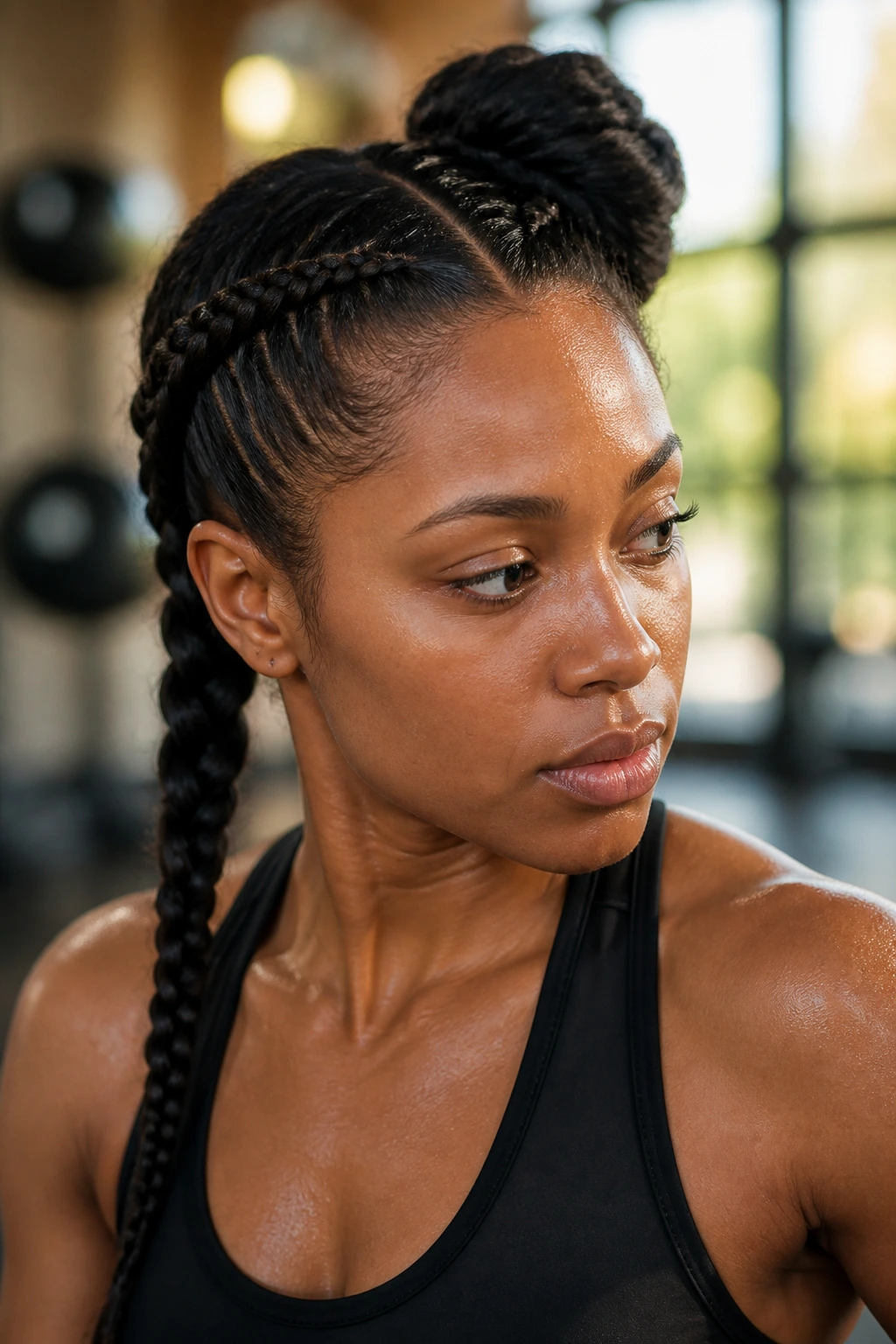
Relying on a single, tight hair tie is a recipe for long-term hair damage. When you run, jump, or lift, your hair moves dynamically, creating a constant tug-of-war between the weight of your hair and the elastic holding it in place. This friction wears down the protective outer cuticle of the hair shaft, leading to those annoying, fuzzy baby hairs that stick up around your crown.
Furthermore, sweat contains sodium and lactic acid, which can dry out the hair shaft, making it more brittle and prone to snapping under high tension. If you immediately pull damp, sweat-soaked hair out of a tight elastic post-workout, you are catching the hair at its weakest point. Wet hair is highly elastic but incredibly fragile, meaning it stretches and snaps far easier than dry hair.
Choosing a smarter styling method distributes the weight of your hair across different sections of your scalp. By incorporating braids, twists, and strategic sectioning, you reduce the direct pressure on any single follicle. This keeps your hair secure during your workout and protects your hairline from thinning over time.
1. The Classic Bubble Ponytail
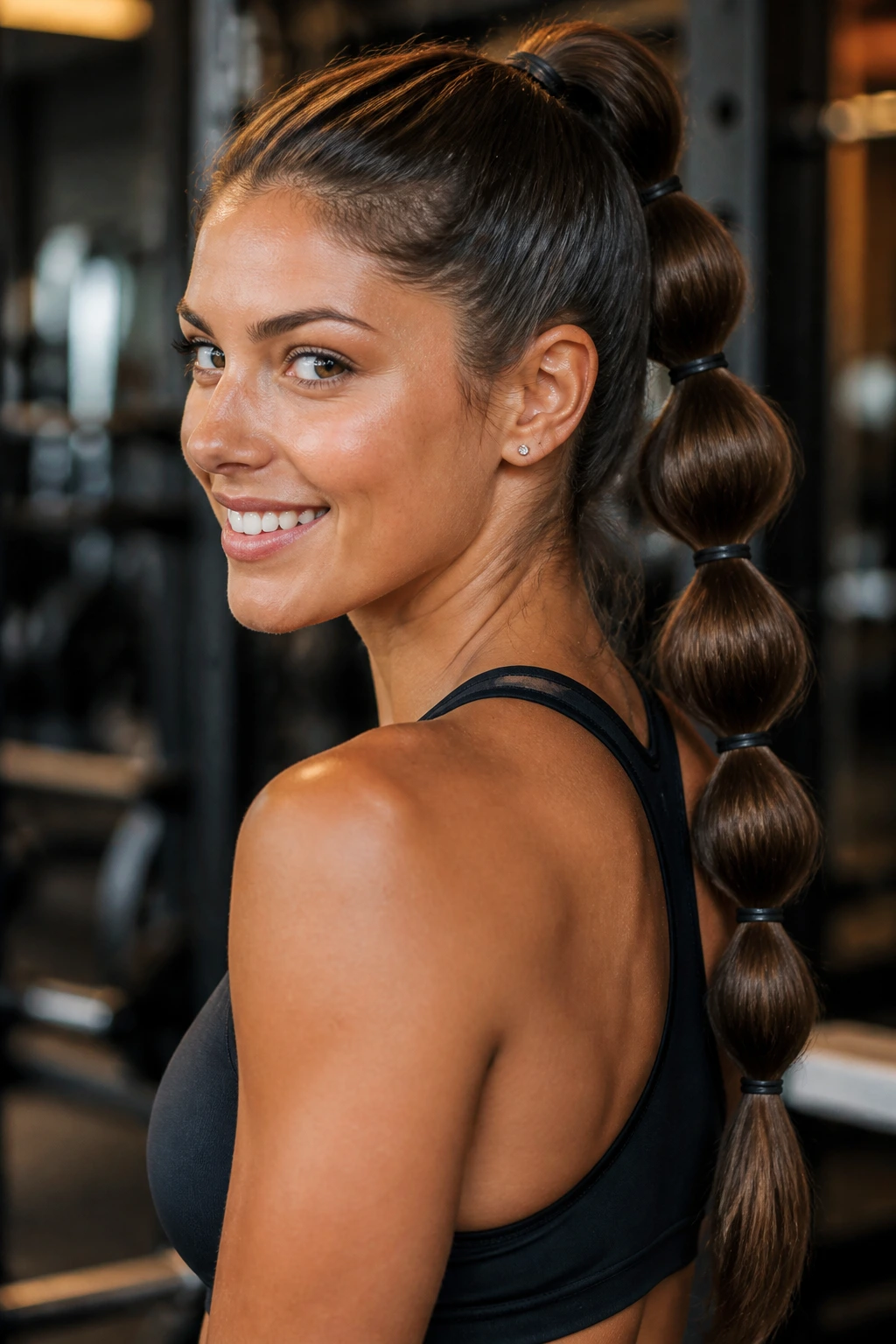
The bubble ponytail is a highly secure alternative to a standard ponytail, particularly for medium to long hair. By placing multiple bands down the length of the ponytail, you prevent the loose ends from whipping around your face or getting caught in gym equipment during dynamic movements.
Why This Structure Prevents Tangles
When you run or jump, loose hair rubs against your back and shoulders, creating a dense mat of tangles at the nape of your neck. The bubble ponytail solves this by locking the length of your hair into controlled segments. Because the hair is restricted between each band, it cannot twist around itself, even during high-impact wind sprints.
How to Get the Look
- Start by gathering the hair at the crown of your head and securing it with a small, metal-free silicone band to create a standard high ponytail.
- Smooth down any flyaways using a clean toothbrush misted with a light-hold styling spray or a touch of hair oil.
- Place a second elastic band roughly two to three inches below the first one, depending on the length of your hair.
- Gently pull at the edges of the section between the two bands to create a rounded, bubble-like shape.
- Repeat this process down the remaining length of your ponytail, spacing the bands evenly until you reach the ends.
Pro tip: Use clear silicone bands that match your hair color to keep the look clean, and ensure they are loose enough to remove without snapping your ends.
2. Double French Braided Buns
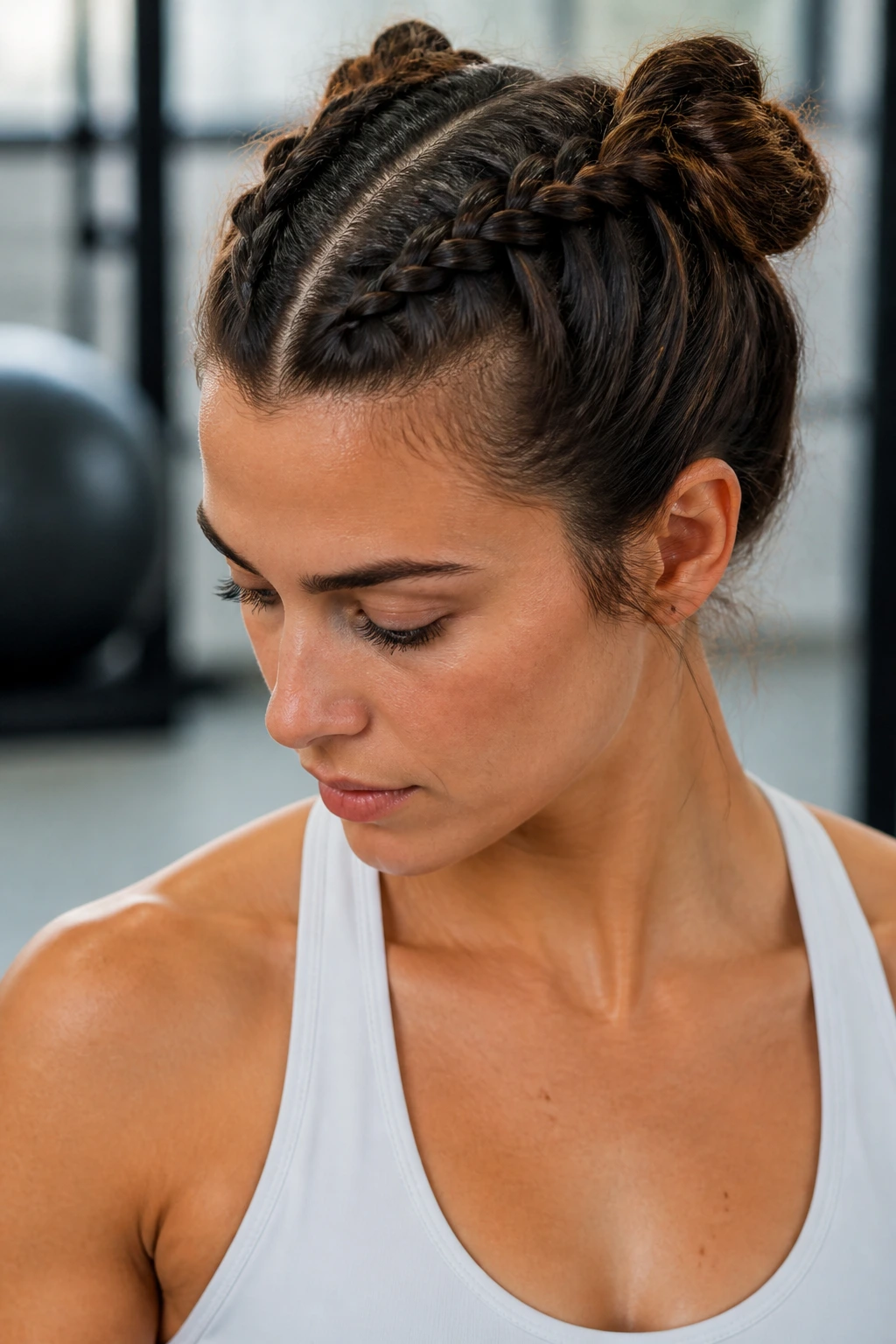
For high-intensity workouts where your head will be in contact with a floor or a mat, such as Pilates, yoga, or bench presses, back-of-the-head ponytails are highly impractical. Double French braided buns keep the entire length of your hair tightly secured against your scalp, leaving the back of your head flat and comfortable.
The Physics of Two Braids
Using two braids instead of one splits the weight of your hair down the center of your scalp. This dual-anchor system prevents the hairstyle from shifting left or right when you perform lateral movements or explosive jumps.
- Split your hair down the middle from the forehead to the nape of the neck using a rat-tail comb to get a clean, straight line.
- Secure one side with a clip to keep it out of the way while you work on the other.
- Begin a classic French braid at the hairline, pulling in small, even sections of hair as you work your way down to the nape.
- Once you reach the base of your neck, secure the braid into a low ponytail with a soft elastic.
- Twist the remaining length of the ponytail into a tight, flat bun and secure it with a few U-shaped hairpins or a spin pin.
- Repeat the identical process on the opposite side of your head.
Pro tip: Spritz your fingers with a light grip spray or water before braiding to keep slippery, clean hair from sliding out of your hands as you braid.
3. The High-Tension Boxer Braids
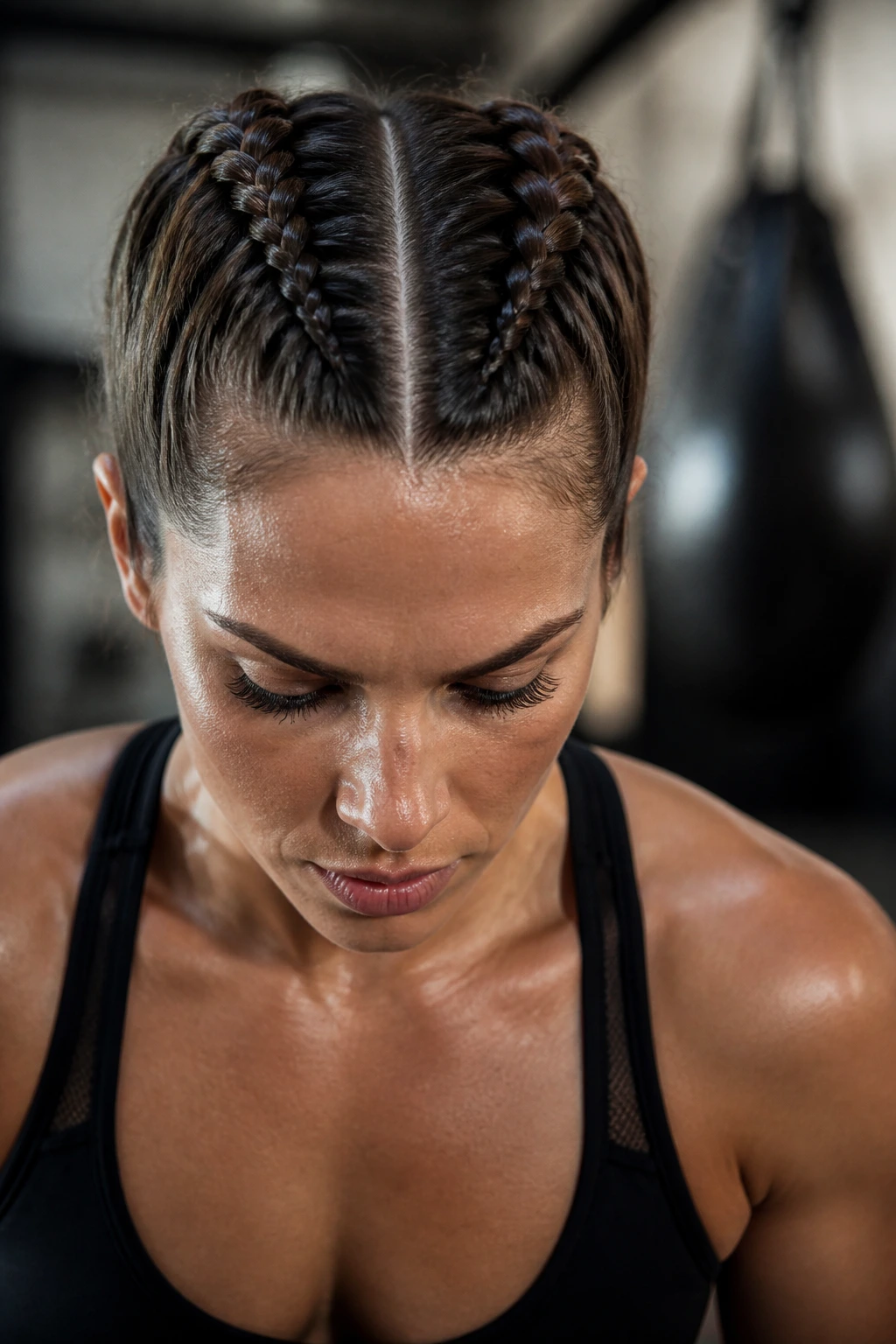
Popularized by athletes in combat sports, boxer braids—technically double Dutch braids—are the gold standard for absolute security. Unlike French braids, where sections are crossed over each other, Dutch braids involve crossing sections under the middle strand, which creates a raised braid that sits snugly on top of the scalp.
Why Dutch Braiding Holds Tighter
Because Dutch braids sit on top of the head rather than under the hair, they compress the hair tightly against the skull. This minimizes the microscopic sliding that happens during repetitive, high-impact movements like running or boxing.
Key Details for Long-Lasting Hold
- Section size: Keep your sections small—no wider than half an inch—to ensure maximum grip on every individual strand.
- Tension control: Maintain a firm, downward pull as you braid, keeping your hands close to the scalp to prevent sagging at the crown.
- Tail security: Braid the entire length of the hair all the way to the very bottom, securing the ends with a heavy-duty silicone band.
- Finishing touch: If you have shorter layers around your ears, secure them with a touch of wax or a flat bobby pin placed flat against the scalp.
4. Segmented Pineapple Updo for Curls
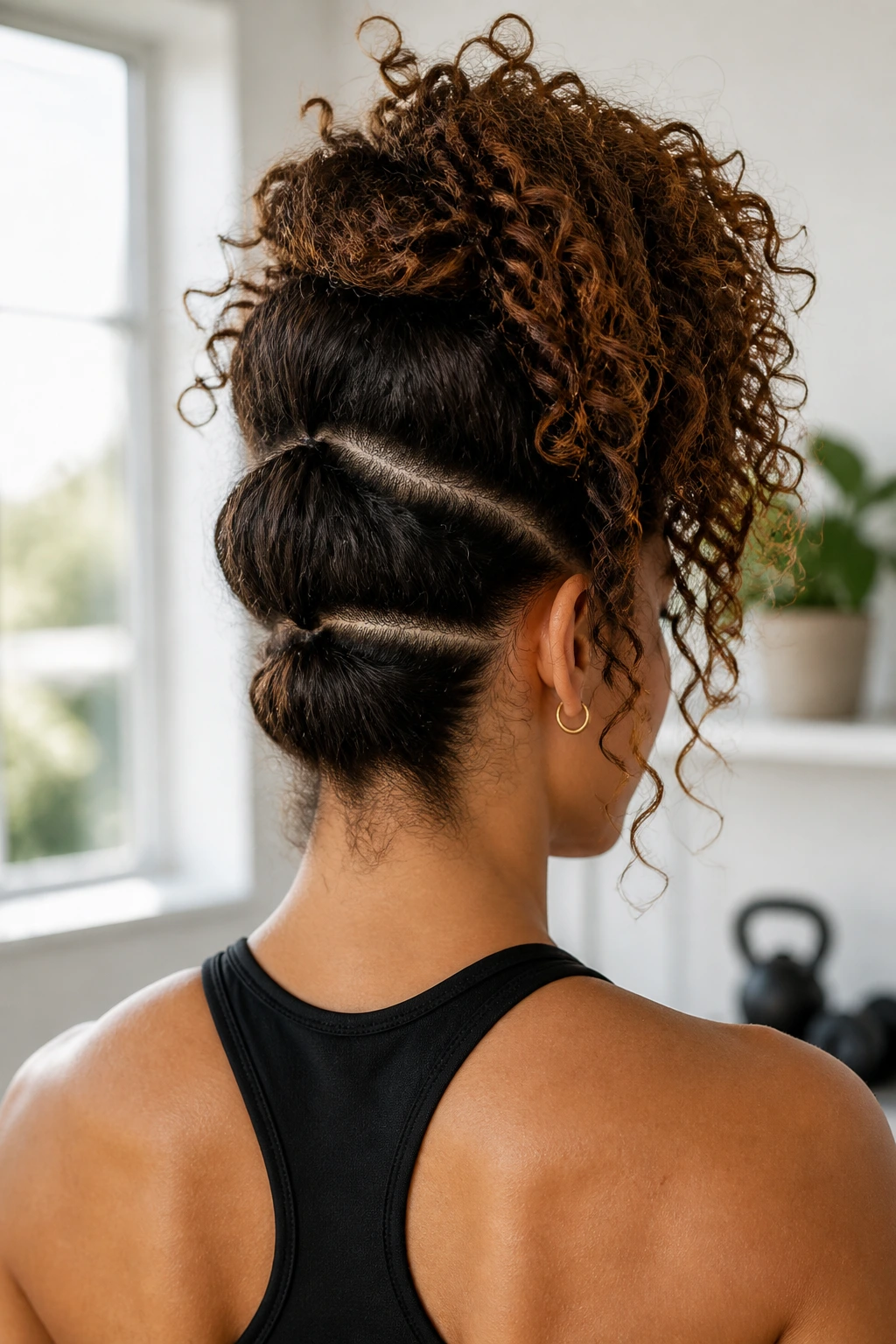
For those with curly, coily, or highly textured hair, standard ponytails can crush the natural curl pattern and cause intense friction at the crown. The pineapple technique is a classic way to protect curls, but adding segments makes it stable enough to withstand a strenuous workout.
Preserving Curl Pattern Under Pressure
The traditional pineapple piles curls loosely on top of the head, which can fall forward during burpees or kettlebell swings. By segmenting the back of the hair, you keep the perimeter secure while allowing the top curls to remain bouncy and undamaged.
- Divide your hair horizontally into three distinct sections: one at the lower nape, one in the middle, and one at the crown.
- Secure the bottom section into a loose ponytail pointing upward, using a soft fabric scrunchie or a spiral cord tie.
- Gather the middle section, combine it with the tail of the bottom ponytail, and secure them together in a second ponytail pointing upward.
- Bring the top section in, combining it with the previous sections at the very top of your head, letting the curls cascade forward.
- Keep the tension light to avoid flattening your natural volume, relying on the segmented base to keep the hair from shifting.
5. The Sleek Low Bun with Claw Clip
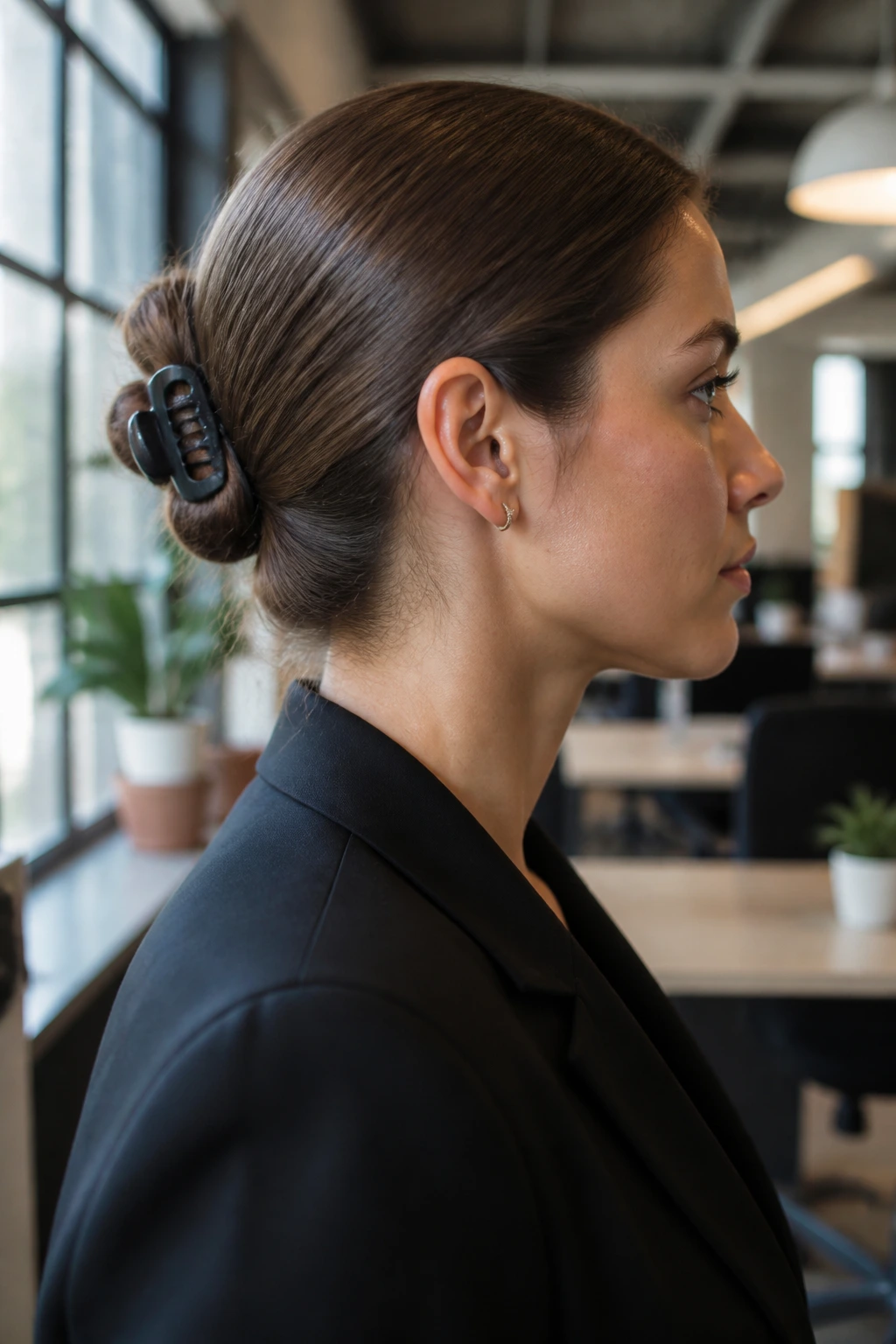
Sometimes you need a hairstyle that transitions from a quick lunch-hour workout to a professional setting without requiring a full wash and blow-dry. A sleek low bun secured with a specialized, flat-backed athletic claw clip is fast, clean, and highly effective for moderate-intensity sessions.
Understanding Claw Clip Mechanics
Standard plastic claw clips have rounded backs that dig into your skull when you lean back on a bench or mat. Seek out modern, flat-profile claw clips made from durable materials like metal or flexible polycarbonate. These sit flush against the head, distributing the pressure evenly if you lie down.
- Part your hair down the center and apply a small amount of leave-in conditioner or hair oil to the length to tame flyaways.
- Gather your hair at the nape of your neck, keeping the tension smooth and even across the sides of your head.
- Twist the length of your hair tightly until it begins to coil in on itself, forming a neat, compact bun.
- Open the flat-backed claw clip and clamp it securely over the top of the bun, catching both the twisted hair and the hair flat against your scalp.
- Tug gently on the sides to ensure the clip has a firm, wobble-free hold on your hair.
6. Triple-Braided High Ponytail
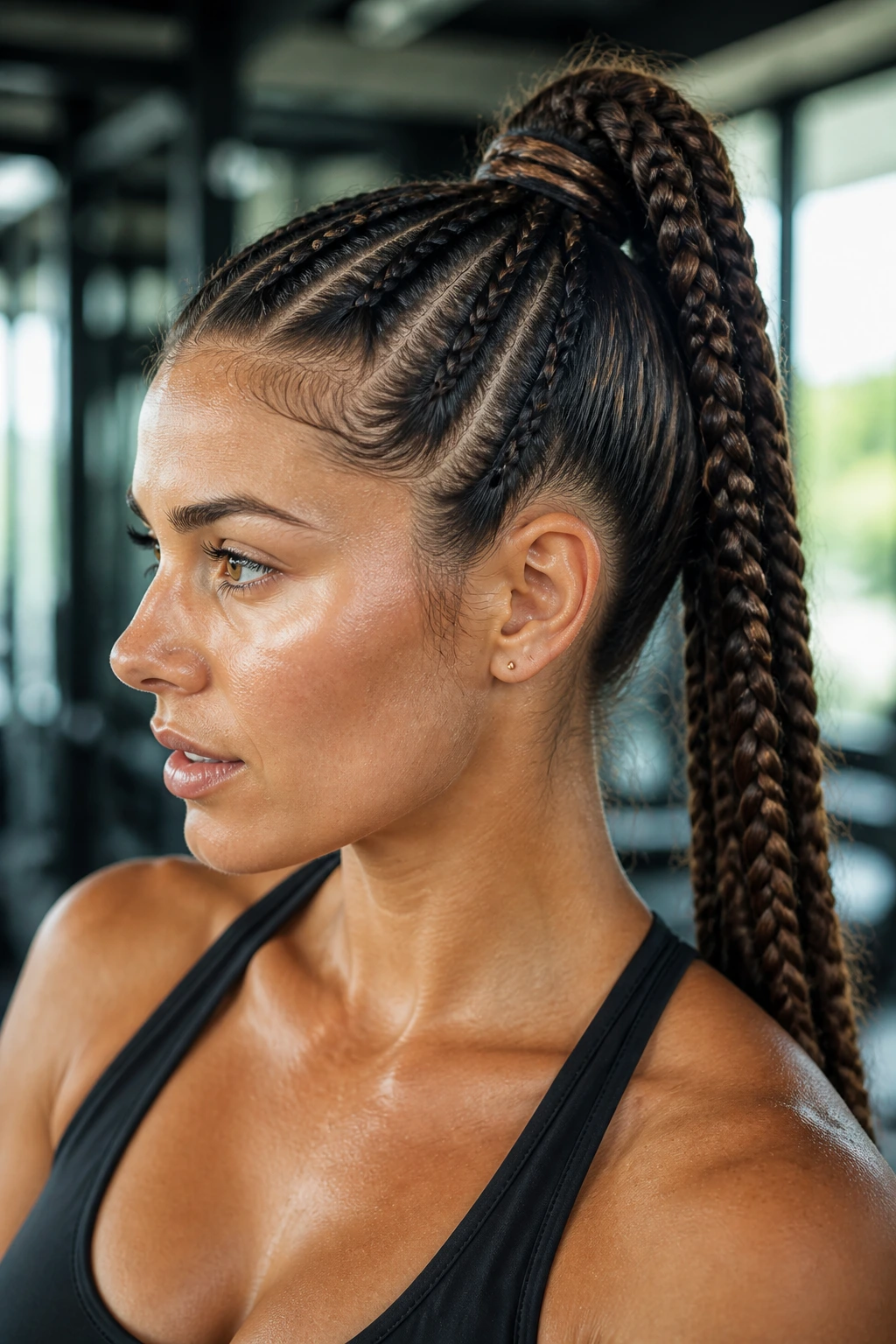
If you have thick, heavy hair, a standard high ponytail will inevitably sag within ten minutes of movement. The weight of the hair pulls the elastic downward, loosening the hold. The triple-braided high ponytail uses structural braiding to distribute that weight and lock the ponytail in place.
The Power of Three Braids
By splitting the ponytail itself into three separate braids, you reduce the aerodynamic drag and whip of the hair during movement. It also prevents the heavy mass of hair from swinging side to side, which is a major cause of tension headaches during long runs.
- Gather all your hair into a high ponytail at the crown of your head and secure it with a heavy-duty, slip-resistant elastic.
- Divide the ponytail length into three equal sections.
- Braid each of the three sections into a tight, simple three-strand braid, securing the ends of each with a small silicone band.
- Take the three individual braids and braid them together into one large, structured braid, securing the final end with a sturdy band.
- This creates a dense, solid column of hair that does not swing wildly or pull at the scalp.
7. The Knotted Athletic Headband Wrap
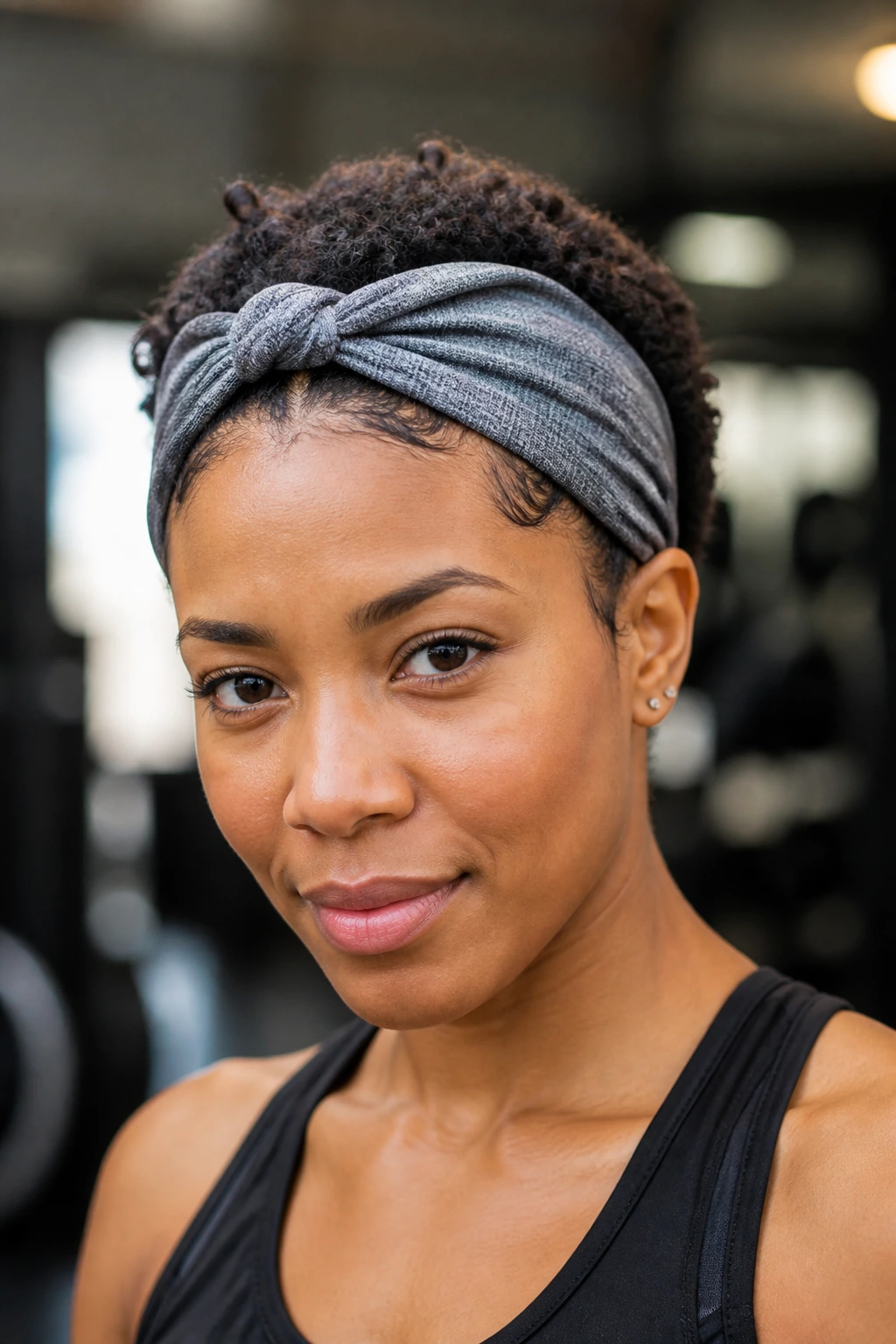
Short hair, such as a bob or a pixie cut with longer layers, can be notoriously difficult to secure during workouts. Pins slip out, and ponytails are too short to hold the front layers. A knotted athletic headband wrap combined with small twists is the ultimate solution for short hair lengths.
Choosing the Right Headband Material
Avoid smooth, synthetic fabrics that easily slide off the back of your head. Look for headbands that feature a silicone grip strip on the inside or are made from a textured, cotton-blend fabric that grabs the hair fibers.
- Twist the front sections of your hair away from your face, working along your hairline from your forehead down to your ears.
- Secure the ends of these twists near your temples using flat, ridge-free bobby pins inserted in a criss-cross pattern.
- Pull the remaining hair back into a small, low pony or pin the bottom sections flat against the nape of your neck if they are too short to tie.
- Slide the athletic headband over your head, positioning the front edge just behind your hairline to lock the twists in place.
- Ensure the back of the band sits low at the base of your skull, below the occipital bone, which prevents it from riding upward during your workout.
8. Crown Braid with Secured Ends
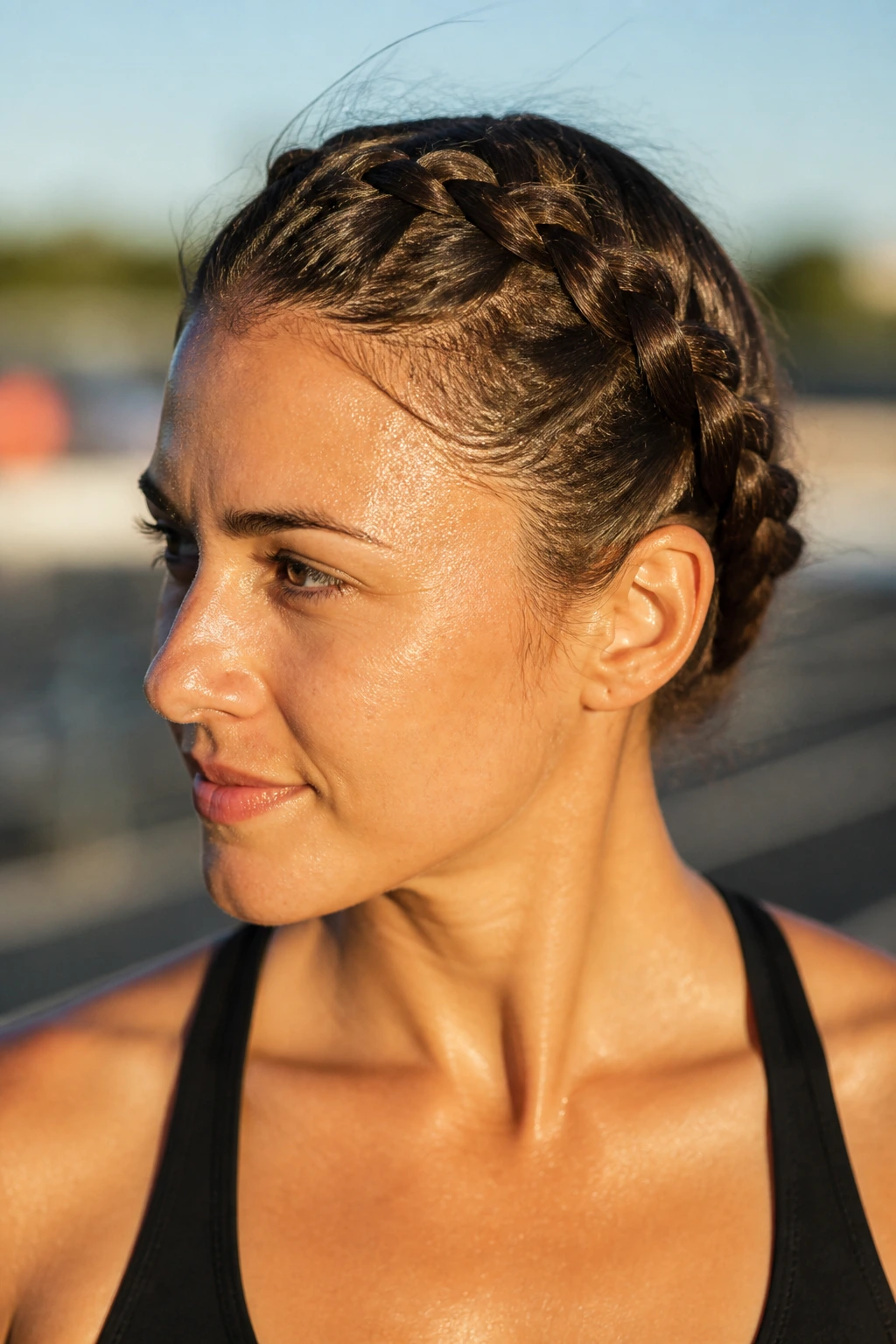
The crown braid is a timeless option that keeps all hair completely off your neck and face. It is particularly well-suited for hot, humid workout environments or outdoor summer training sessions where heat management is a priority.
Keeping Your Neck Cool
When hair rests on wet skin, it absorbs sweat, which weighs down the hair and clogs the pores on your neck and back. Elevating every single strand onto the crown of the head keeps your neck clear, allowing sweat to evaporate naturally.
- Part your hair down the middle and begin French braiding on one side of your head, starting near the nape of your neck.
- Braid upward toward your ear, across your forehead, and down the other side of your head, creating a continuous circle of braided hair.
- Feed new sections of hair into the braid only from the outside perimeter to keep the center flat and smooth.
- Once you reach your starting point, tuck the remaining loose braided tail underneath the beginning of the braid.
- Pin the tucked tail securely using three or four large U-shaped hairpins, pushing them parallel to your scalp for a secure, comfortable hold.
9. The Double-Strap Spun Bun
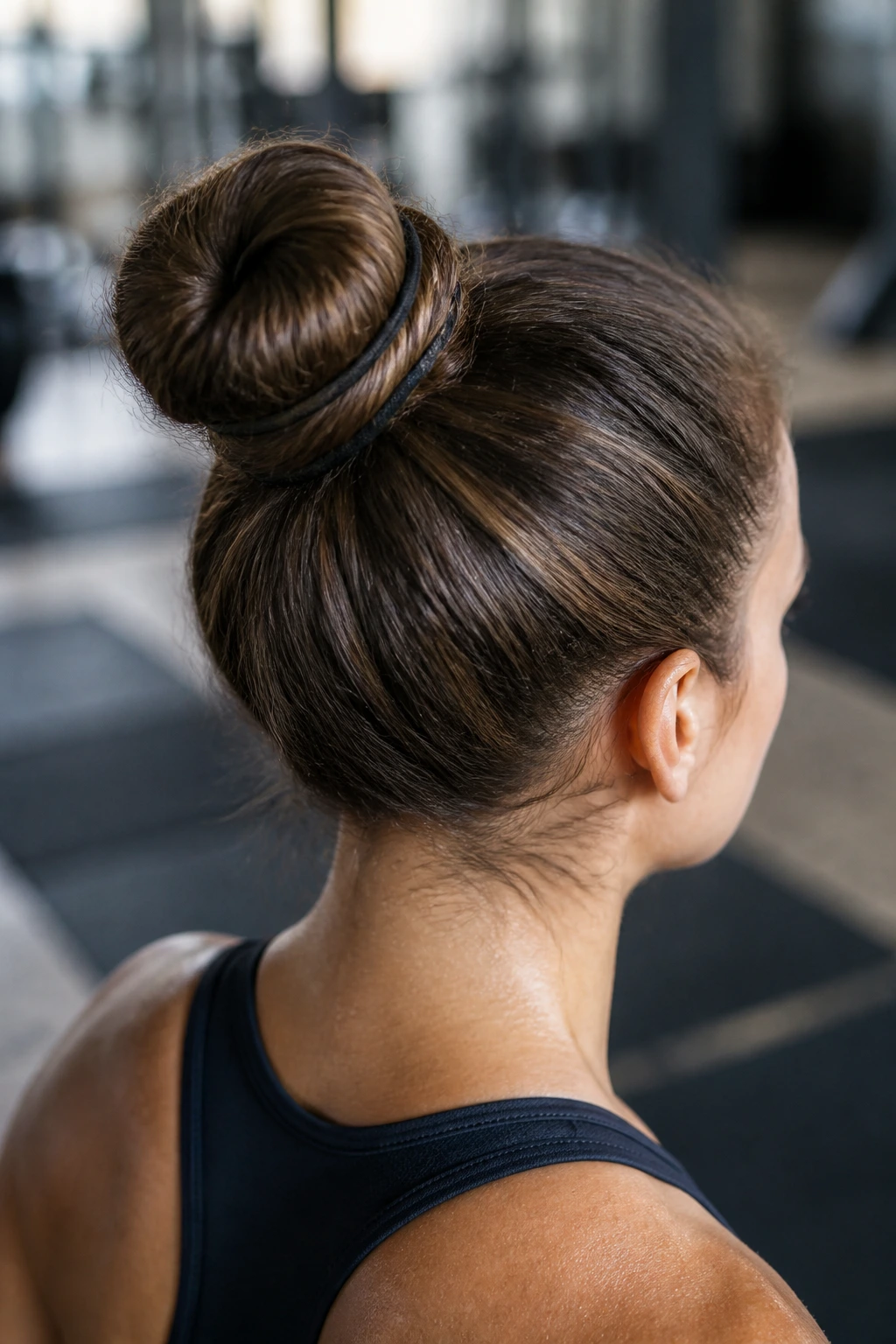
When you are performing intense, explosive movements like box jumps, kettlebell clean-and-jerks, or burpees, your hair experiences high G-forces. The double-strap spun bun uses two independent elastic anchors to ensure the bun cannot wobble or come undone.
Dual-Elastic Security
Most buns fail because the single hair tie holding the base also has to hold the weight of the bun itself. By separating these two tasks with two distinct elastics, you double the stability of the hairstyle.
- Gather your hair at the mid-point of your head, right in line with your ears, and secure it with your first high-quality hair elastic.
- Twist the ponytail tightly, then wrap it around the base of the elastic to form a compact, circular bun.
- Take a second, slightly wider elastic band or a strong fabric scrunchie and stretch it directly over the entire bun, doubling it over if necessary.
- Insert a single, heavy-duty spin pin through the side of the bun, catching both the wrapped hair and the base hair.
- This creates a virtually indestructible bun that stays perfectly centered, no matter how much you jump or shake your head.
10. Fishtail Ponytail with Silicone Bands
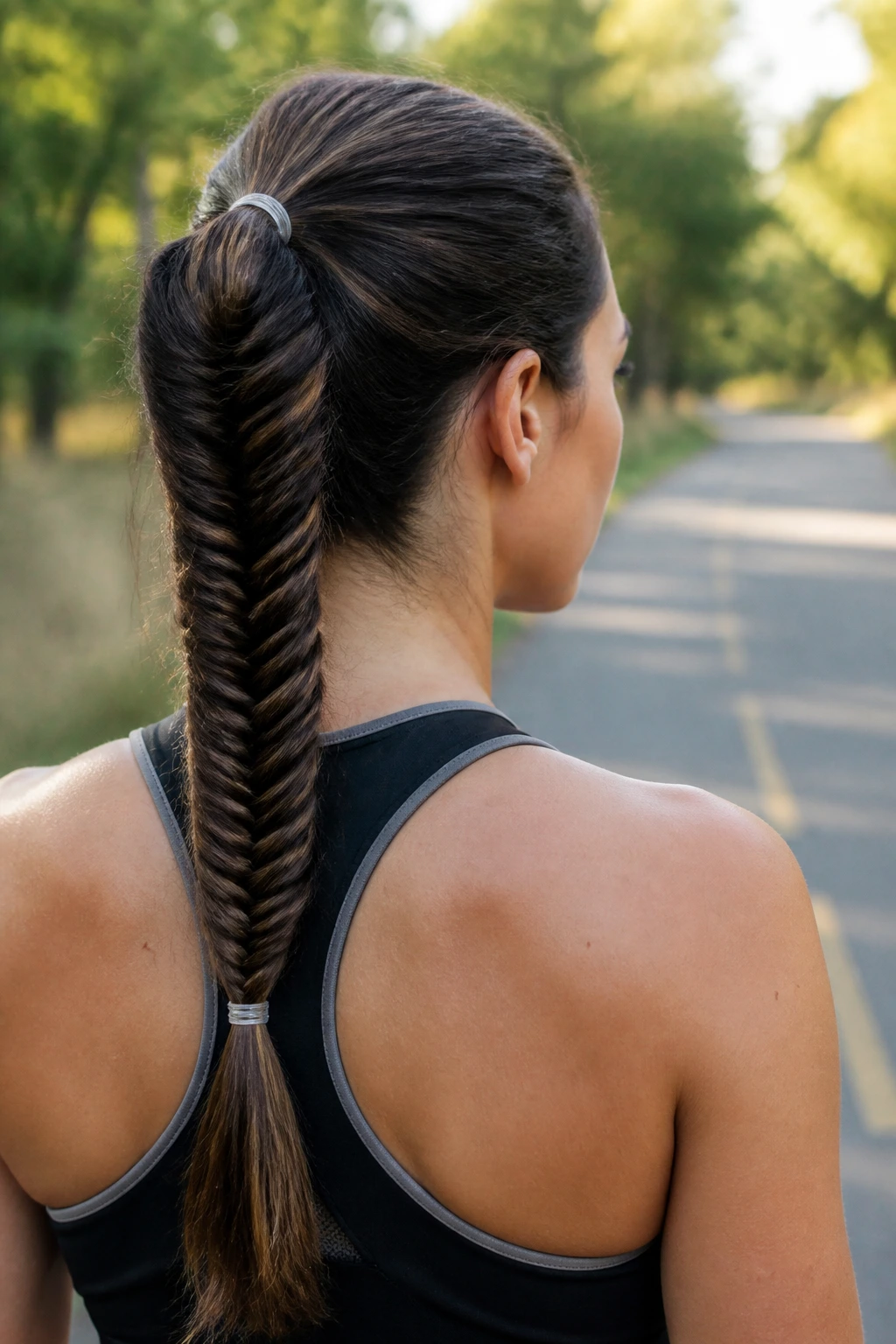
A fishtail braid looks complex, but its tight, interlaced structure makes it incredibly durable for workouts. Unlike a standard three-strand braid, a fishtail uses four alternating sections, which creates a flatter, denser braid that resists fraying.
Preventing Frizz in High Humidity
If you exercise outdoors in the wind or rain, fine hair will quickly work its way out of a standard braid, creating a halo of frizz. The tight weave of a fishtail braid locks individual strands deep within the structure, keeping the style looking clean from start to finish.
- Pull your hair into a sleek ponytail at the nape of your neck and secure it with a soft fabric band.
- Split the ponytail into two equal halves.
- Take a small, thin strand of hair from the outer edge of the left section and cross it over to join the right section.
- Take an equal strand from the outer edge of the right section and cross it over to join the left section.
- Repeat this alternating pattern down the length of the ponytail, keeping your tension tight and consistent.
- Secure the end with a small silicone band, and then place an extra silicone band in the middle of the braid for added reinforcement.
11. The Origami Space Buns
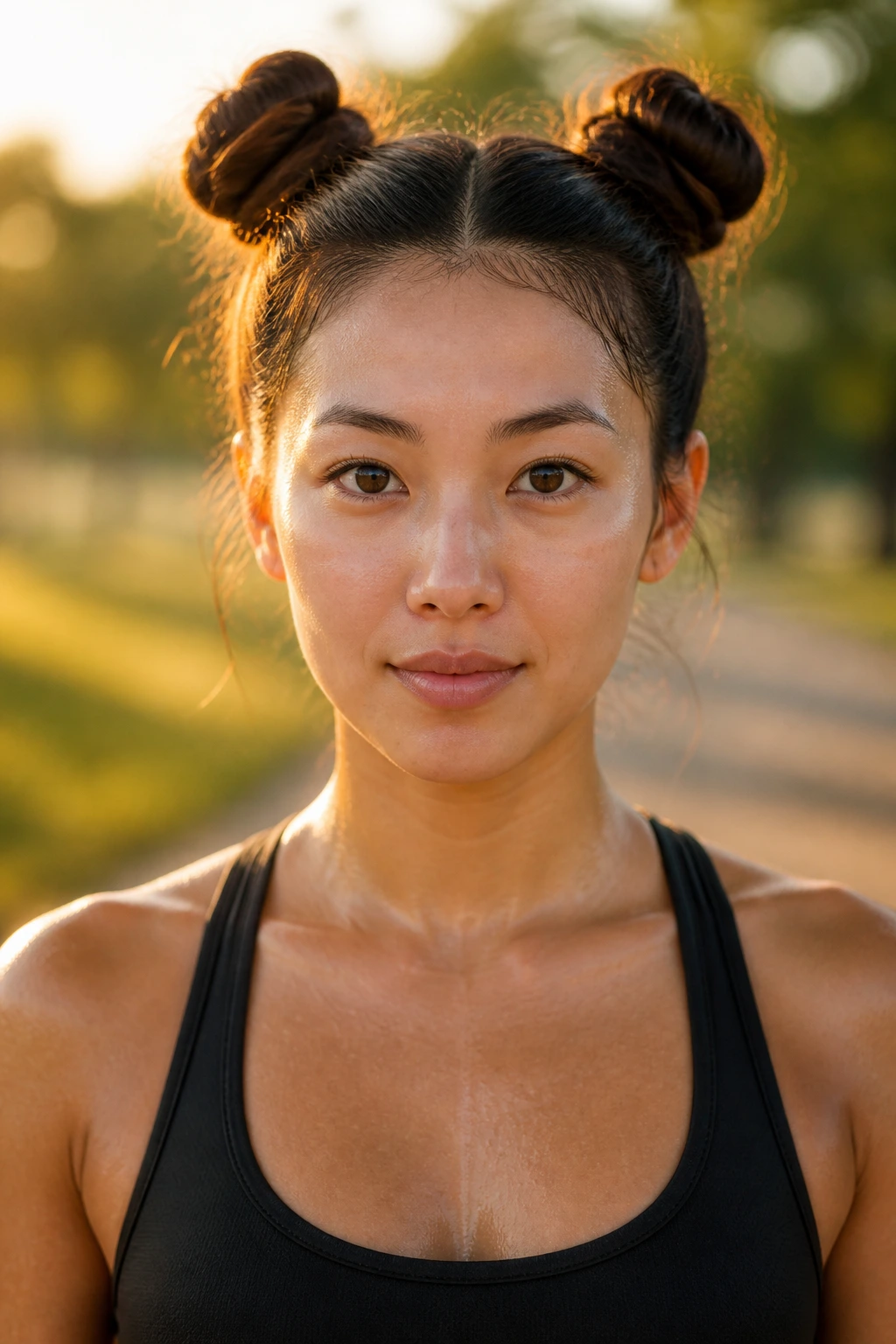
For a balance of fun and high-performance utility, double high buns—often called space buns—keep your hair completely split and elevated. This is an excellent choice for thick hair that feels too hot when compiled into a single, massive bun on top of the head.
Distributing the Weight of Thick Hair
A single high bun can put immense pressure on the center of the scalp, leading to tension headaches. Space buns split that load, allowing you to train longer without feeling scalp fatigue.
- Divide your hair down the center into two equal sections, ensuring the part is clean and straight.
- Tie each section into a high ponytail on either side of your crown, securing them tightly with soft elastic bands.
- Twist each ponytail until it begins to wrap around its own base, forming a neat, round bun.
- Secure each bun with a soft fabric scrunchie, which provides a cushioned hold without cutting into the hair shaft.
- If you have shorter layers underneath, use flat bobby pins to secure them upward toward the base of the buns.
12. Half-Up Top Knot with Grip Pins
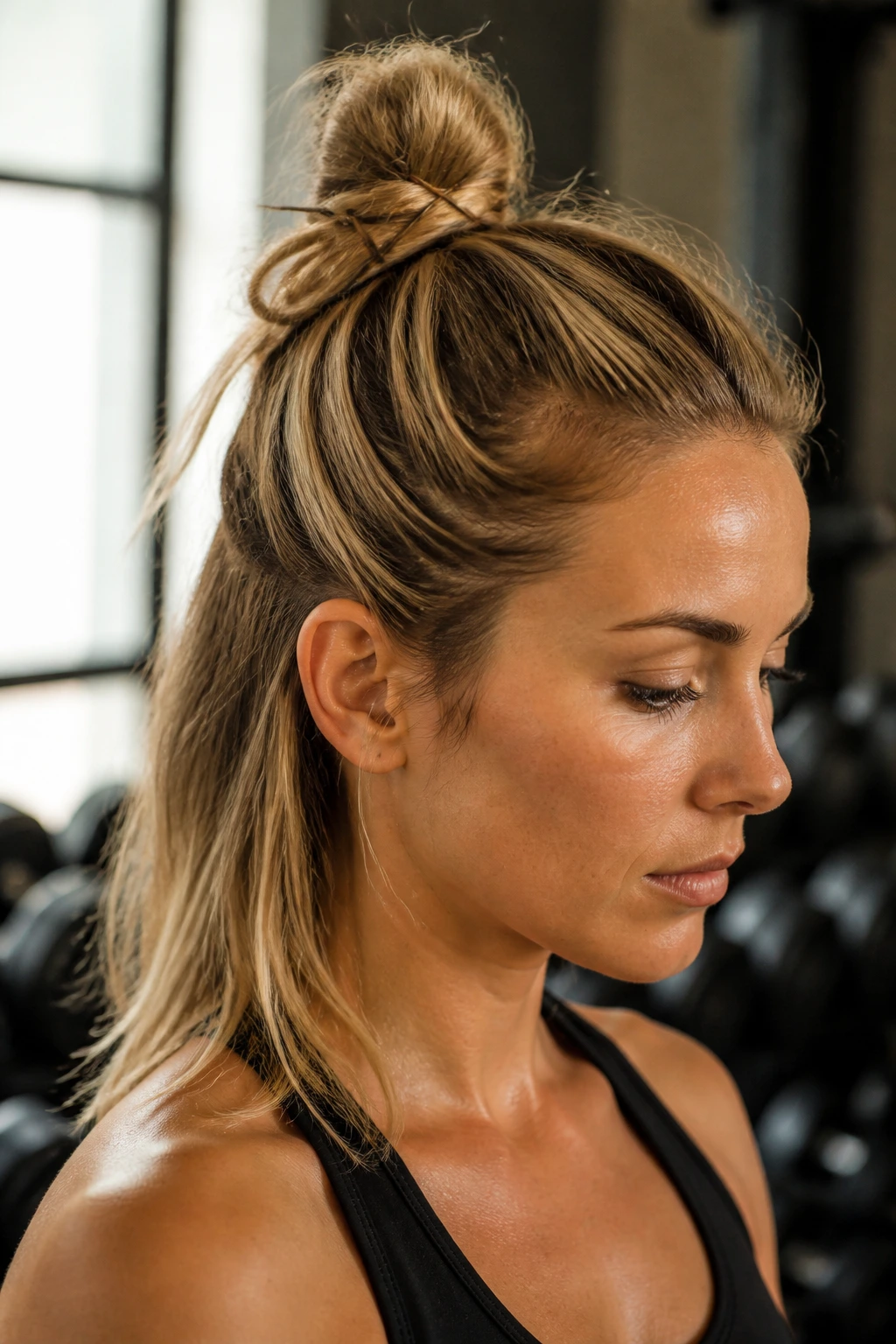
If you have a lob or medium-length hair with a lot of shorter layers around the face, a full updo can feel frustrating because the bottom sections keep falling out. A half-up top knot secures the critical “distraction zone”—the hair around your forehead and eyes—while letting the back hang free.
The Focus-Zone Solution
The primary goal of a workout hairstyle is to keep hair out of your eyes and off your face. By securing only the top half of your hair, you eliminate the distraction of falling strands while avoiding the tension of forcing short bottom layers into a high tie.
- Section off the top portion of your hair, starting from the arches of your eyebrows and diagonal up to the crown of your head.
- Smooth this top section back, ensuring there are no loose bumps or bubbles near your hairline.
- Twist this section into a small, tight knot at the very top of your head, keeping it forward-facing.
- Secure the base of the knot with a small, sturdy hair tie, then slide two grip pins through the sides for extra stability.
- Leave the bottom half of your hair loose, or if it feels too warm on your neck, pin the bottom ends into a small, low pony.
13. The French Twist Athletic Clip Roll
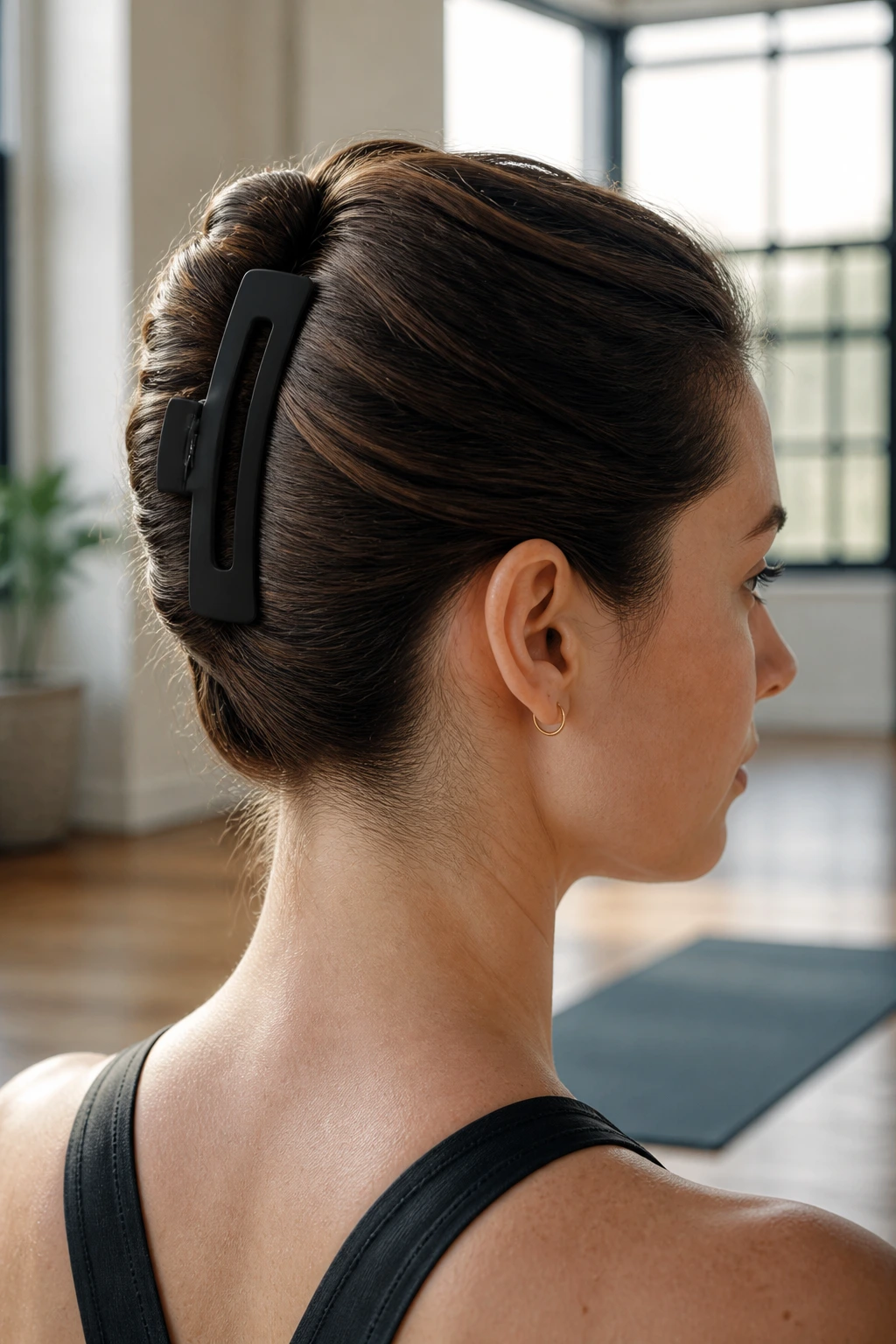
For low-impact workouts like yoga, stretching, or walking, you might want a quick, elegant way to tuck your hair away without using tight elastics. The French twist athletic clip roll uses a long, flat jaw clip to hold the hair flat against the back of your head.
Comfort in Horizontal Poses
Traditional buns stick out, making it impossible to lie comfortably on your back during yoga poses like Savasana. This twist rolls the hair into a flat, vertical column, allowing your head to rest naturally on the mat.
- Gather your hair at the nape of your neck as if making a low ponytail, but do not tie it.
- Begin twisting the hair upward, pulling it taut against the back of your head.
- As you twist, the hair will naturally form a neat vertical roll along the center of your head.
- Tuck the remaining ends of the hair inside the top of the roll to hide them.
- Take a long, flat, multi-toothed athletic clip and clamp it along the length of the twist, securing the roll flat against your skull.
14. Sectioned Piggyback Ponytails
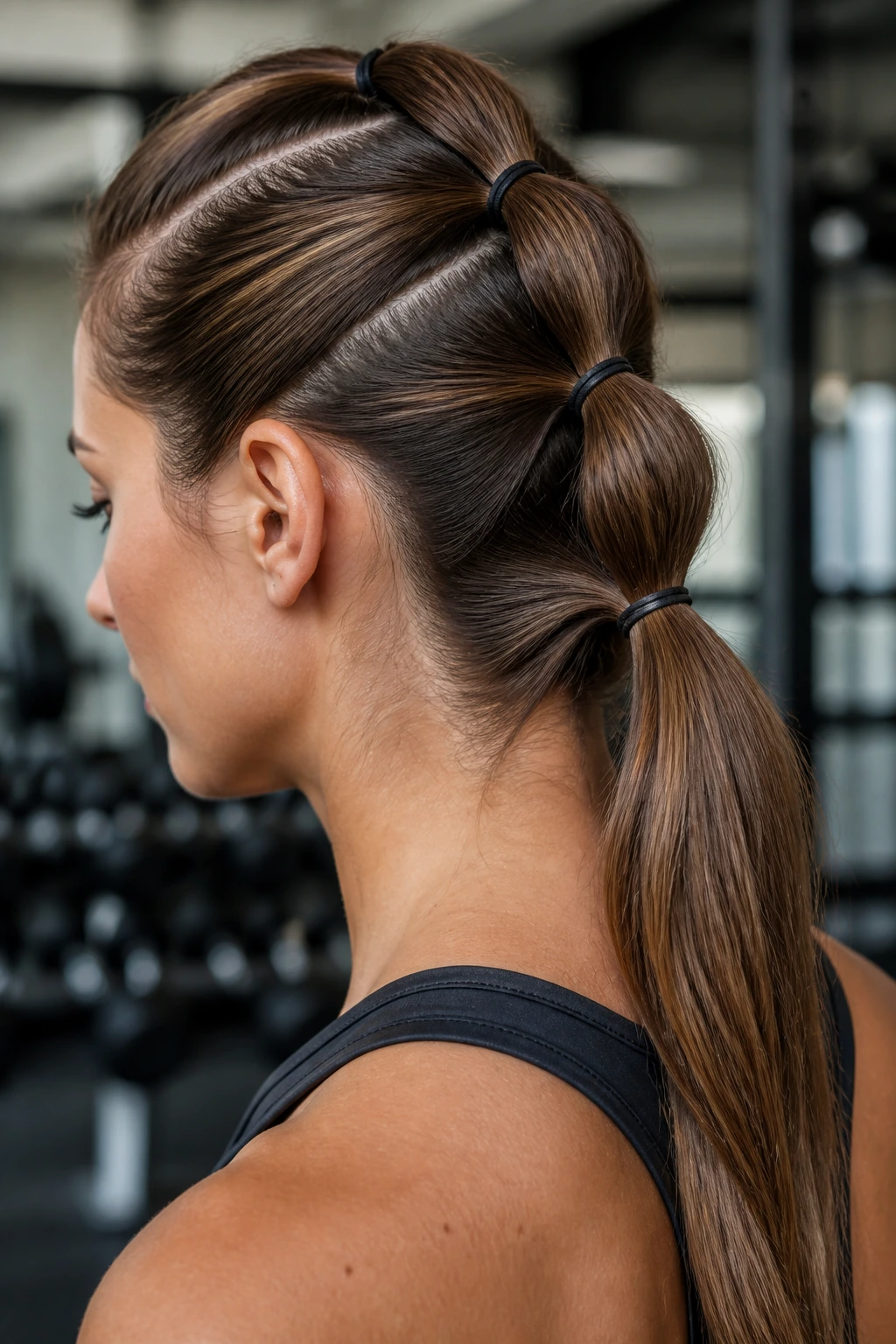
If you have extremely fine or slippery hair, elastics tend to slide down the hair shaft during a workout, causing the style to sag. Sectioned piggyback ponytails use a series of connected ties to lock the hair in place, ensuring the style cannot slide.
Mechanical Grip for Fine Hair
Slippery hair lacks the natural texture to hold an elastic under movement. By linking multiple ponytails together, each section acts as an anchor for the next, preventing any downward slippage.
- Start by parting a small, square section of hair at the very front of your hairline, right above your forehead.
- Secure this first section with a small silicone band to make a tiny ponytail.
- Create a second section of hair directly behind the first one, pulling in the tail of your first ponytail as you tie it.
- Repeat this step a third and fourth time, working your way down the back of your head in a clean, connected chain.
- Gather the final tail along with the remaining hair at the nape of your neck and secure it into one final, low ponytail.
15. The Cornrow Puff Combo
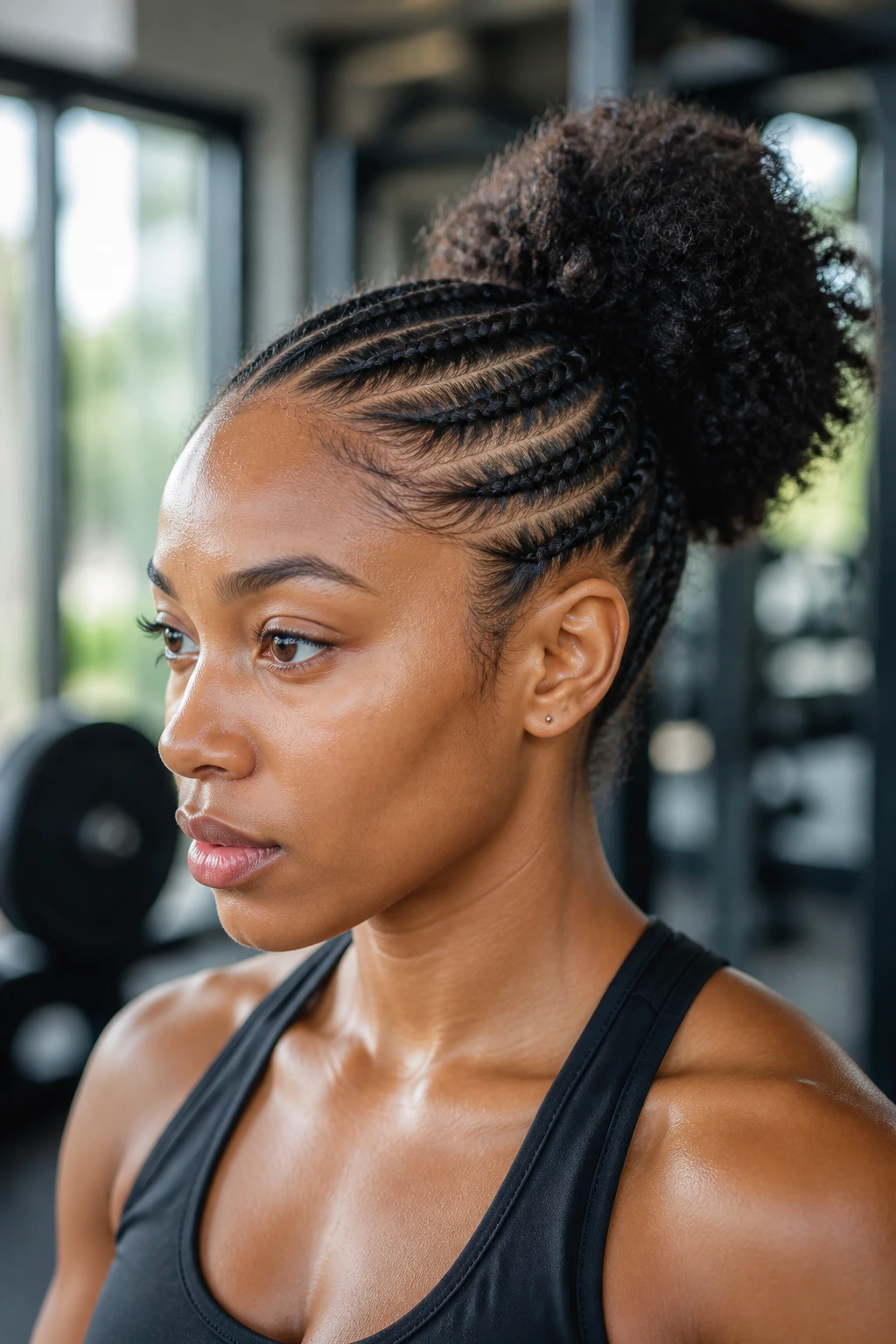
This style is perfect for those with natural, coily, or highly textured hair who want a low-tension option that keeps hair back but showcases natural texture. It combines the security of flat cornrows at the front with a puff at the back.
Balancing Tension and Protection
Continuous tight pulling on natural hair can lead to damage along the fragile hairline. By cornrowing just the front section, you keep the face clear while letting the back remain in a low-tension, voluminous puff.
- Section off the front two to three inches of your hair, from ear to ear.
- Divide this front section into four or five smaller vertical sections.
- Braid each small section flat against the scalp in a neat cornrow, working from your hairline back toward your crown.
- Secure the ends of the braids with small, painless bands once you reach the crown.
- Gather the remaining unbraided hair at the back along with the ends of your braids, and secure them into a high puff using a soft, adjustable satin hair band.
16. Crossed Criss-Cross Dutch Braids
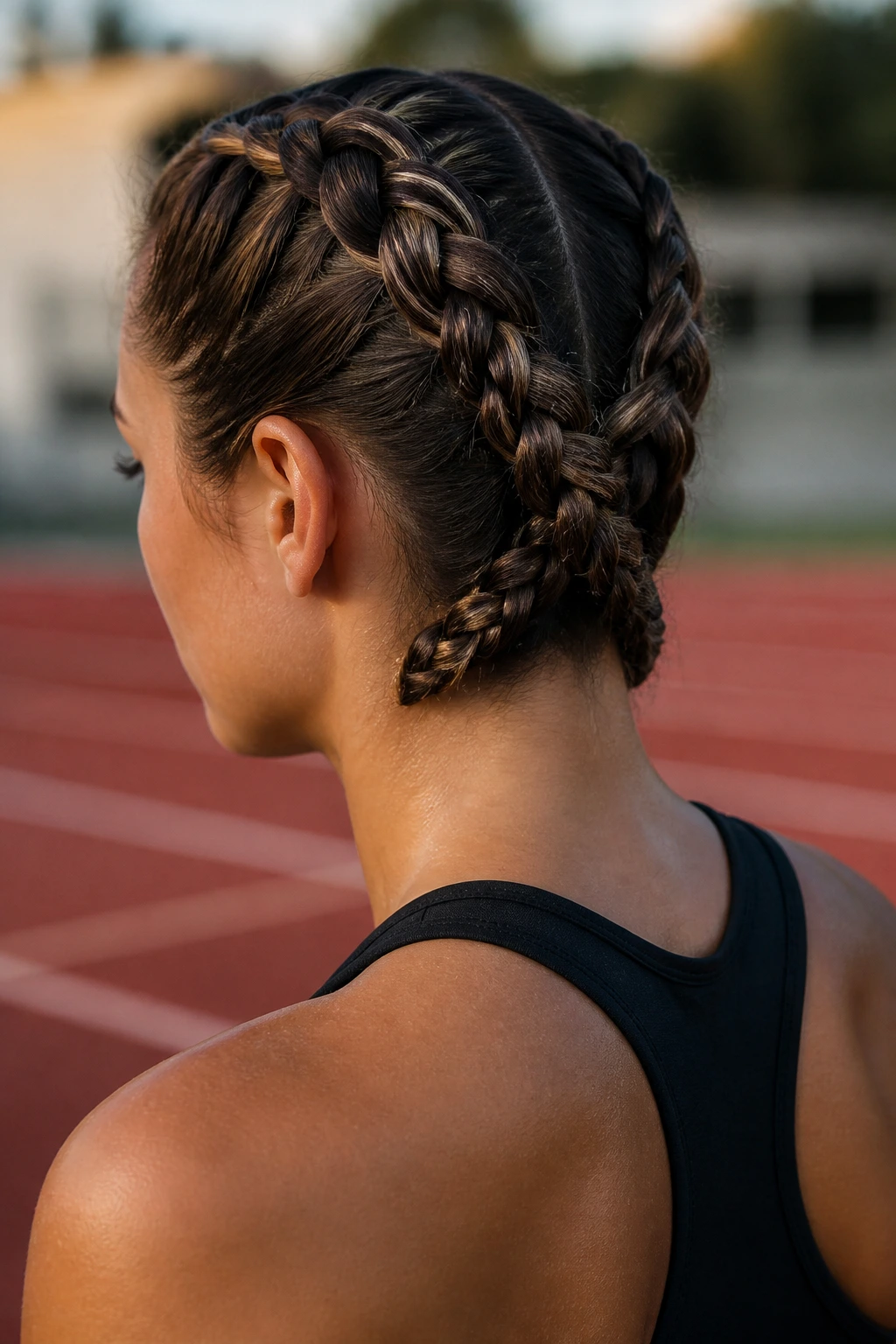
For those who find standard double braids boring, the criss-cross Dutch braid offers an intricate look with exceptional security. By crossing the braids over each other at the back of the head, you lock the hair flat against the skull.
Advanced Structural Support
When braids cross over each other, they create a natural tension point that prevents either braid from sliding. This is an incredible option for high-impact sports like soccer, basketball, or track and field.
- Divide your hair into four quadrants: two at the top front and two at the bottom back.
- Begin a Dutch braid in the top-left quadrant, working diagonally toward the center of your head.
- When you reach the middle, cross the braid over to the bottom-right quadrant, incorporating the hair from that section into the braid.
- Repeat the process starting with the top-right quadrant, crossing it over to the bottom-left quadrant.
- Secure each of the two finished diagonal braids at the nape of your neck with sturdy, slip-free bands.
17. The Sleek Chignon with No-Slip Grip
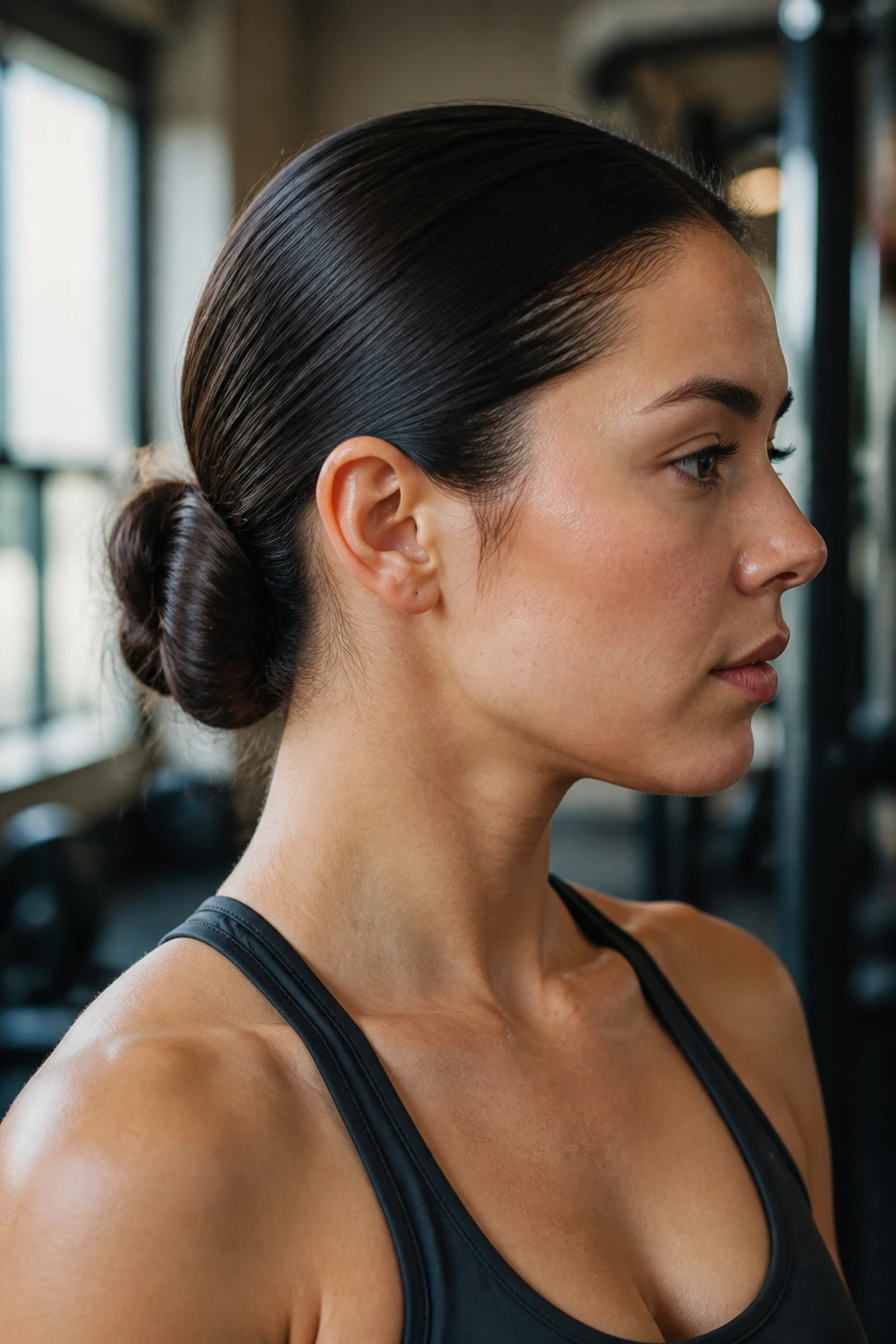
A chignon is a sophisticated low bun that can be adapted for athletic performance by using high-grip pins and a smooth, secure wrap technique. It keeps your hair compact and close to the nape of your neck, making it ideal for cyclists who need to wear a helmet.
Helmet-Friendly Hair
Finding a hairstyle that fits comfortably under a bike or climbing helmet can be difficult. High ponytails and bulky buns interfere with the adjustment dial at the back of the helmet, while low ponytails can get caught in the straps. The sleek chignon sits flat and low, completely clearing the helmet’s harness.
- Pull your hair into a low, smooth ponytail at the very base of your neck, securing it with a thin, strong elastic.
- Split the hair directly above the elastic to create a small opening, then loop the ponytail up and through the opening to create a flipped twist.
- Roll the remaining tail of the ponytail upward toward the base of the skull, tucking the ends into the hollow space of the twist.
- Secure the rolled hair in place using flat, high-grip bobby pins pushed horizontally along the nape of your neck.
- Smooth any flyaways along your neck with a light touch of natural pomade or styling wax.
18. Twisted Halo Braid for Short Hair
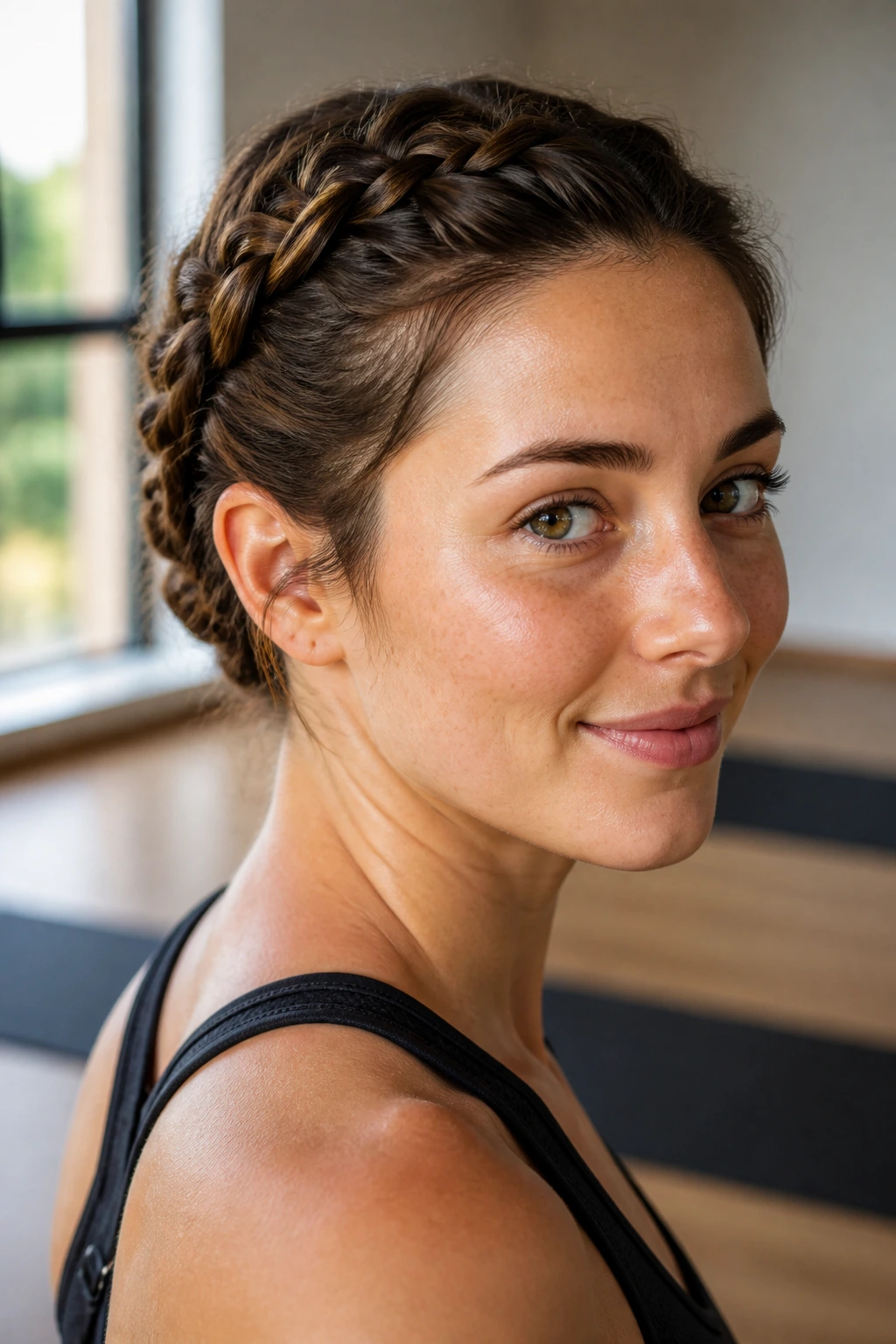
If your hair is too short for a full crown braid, a twisted halo braid offers a similar level of security and heat management. Instead of three-strand braiding, this technique uses two-strand twists, which are much easier to execute on short, layered hair.
The Ease of Two-Strand Twists
Two-strand twisting is faster than traditional braiding and allows you to incorporate short layers without them poking out of the braid. It creates a beautiful, rope-like halo around your head that holds tight during yoga or weightlifting.
- Part your hair down the center and start on one side near your forehead.
- Take two small sections of hair at your hairline and twist the front section over the back section.
- Add a small amount of loose hair to each strand before twisting them again, working your way down the side of your head.
- Keep the twist tight and close to your scalp, following the natural curve of your hairline around to the back of your neck.
- Secure the end of the twist with a small bobby pin, then repeat the process on the other side of your head.
- Join the two twists at the back of your neck, tucking the ends under each other and pinning them flat against your scalp.
How to Protect Your Hair from Sweat Damage
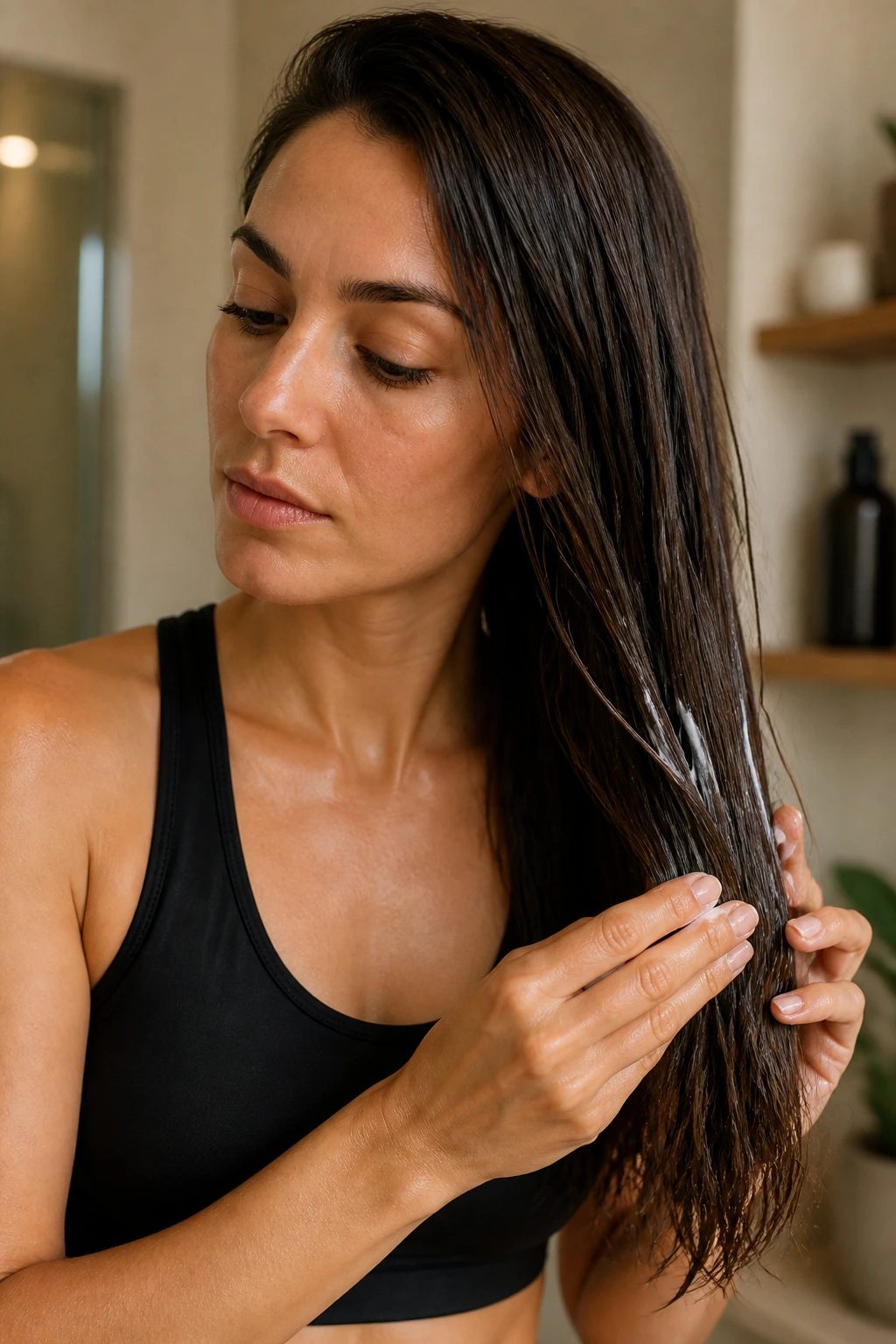
Managing your hair during a workout is only half the battle; protecting it from the drying effects of sweat is just as important. Sweat is primarily composed of water, salt, and trace minerals. When sweat dries on your scalp and hair, the salt can strip away your hair’s natural moisture, leaving the outer cuticle rough, dry, and prone to tangling.
To prevent this, treat your hair before you even begin your workout. Applying a light layer of leave-in conditioner or a few drops of jojoba oil to your mid-lengths and ends before styling creates a protective barrier. This barrier prevents the salty sweat from penetrating the hair shaft, making it much easier to detangle and wash post-workout.
After your workout, try to rinse your hair as soon as possible. If you do not have time for a full wash, rinse your scalp with cool water to remove the salt buildup, then blow-dry your roots on a cool setting. Using a dry shampoo before your workout can also help absorb sweat as it occurs, keeping your scalp fresher for longer.
Quick Prep Checklist
- Apply a light leave-in conditioner to dry ends before styling.
- Use a natural hair oil (like jojoba or argan) to seal the hair cuticle.
- Spritz dry shampoo on your roots before you start sweating to absorb moisture.
- Avoid using heavy gel or hairspray, which can mix with sweat and clog scalp pores.
The Best Hair Ties and Accessories for High-Intensity Training
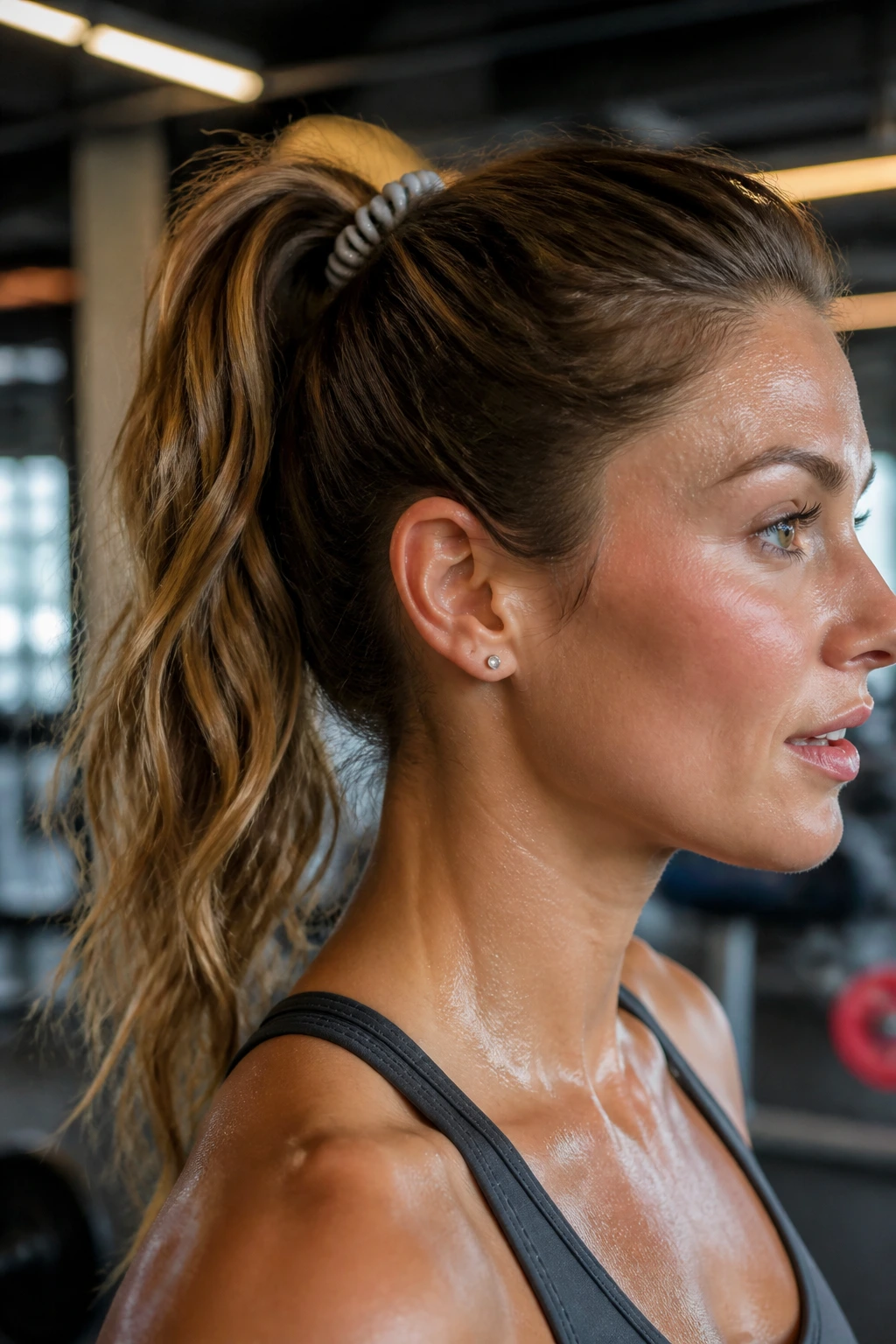
The accessories you use to secure your hair are just as important as the style itself. Cheap, rubbery elastics or metal-clasped ties cut into the hair shaft, causing weak points that eventually snap. Investing in high-quality, workout-specific hair accessories will protect your hair and keep your styles secure.
+------------------------+------------------------------------+------------------------------------+
| Accessory Type         | Best Used For                      | Why It Works                       |
+------------------------+------------------------------------+------------------------------------+
| Silicone Spiral Bands  | High-impact running, jumping       | Spreads tension, doesn't absorb    |
|                        |                                    | sweat, holds without slipping      |
+------------------------+------------------------------------+------------------------------------+
| Satin/Silk Scrunchies  | Low-intensity, yoga, rest days     | Reduces friction, prevents creases,|
|                        |                                    | gentle on fragile hair             |
+------------------------+------------------------------------+------------------------------------+
| No-Slip Bobby Pins     | Securing flyaways, short layers    | Matte coating prevents sliding,    |
|                        |                                    | holds tight against sweat          |
+------------------------+------------------------------------+------------------------------------+
| Seamless Fabric Ties   | Thick hair, high ponytails         | Heavy-duty support without cutting |
|                        |                                    | into the hair shaft                |
+------------------------+------------------------------------+------------------------------------+
Choosing the right accessory for your specific hair type and workout intensity makes a massive difference in both comfort and hair health. Keep a variety of these tools in your gym bag so you are always prepared for any workout.
Wrapping Up
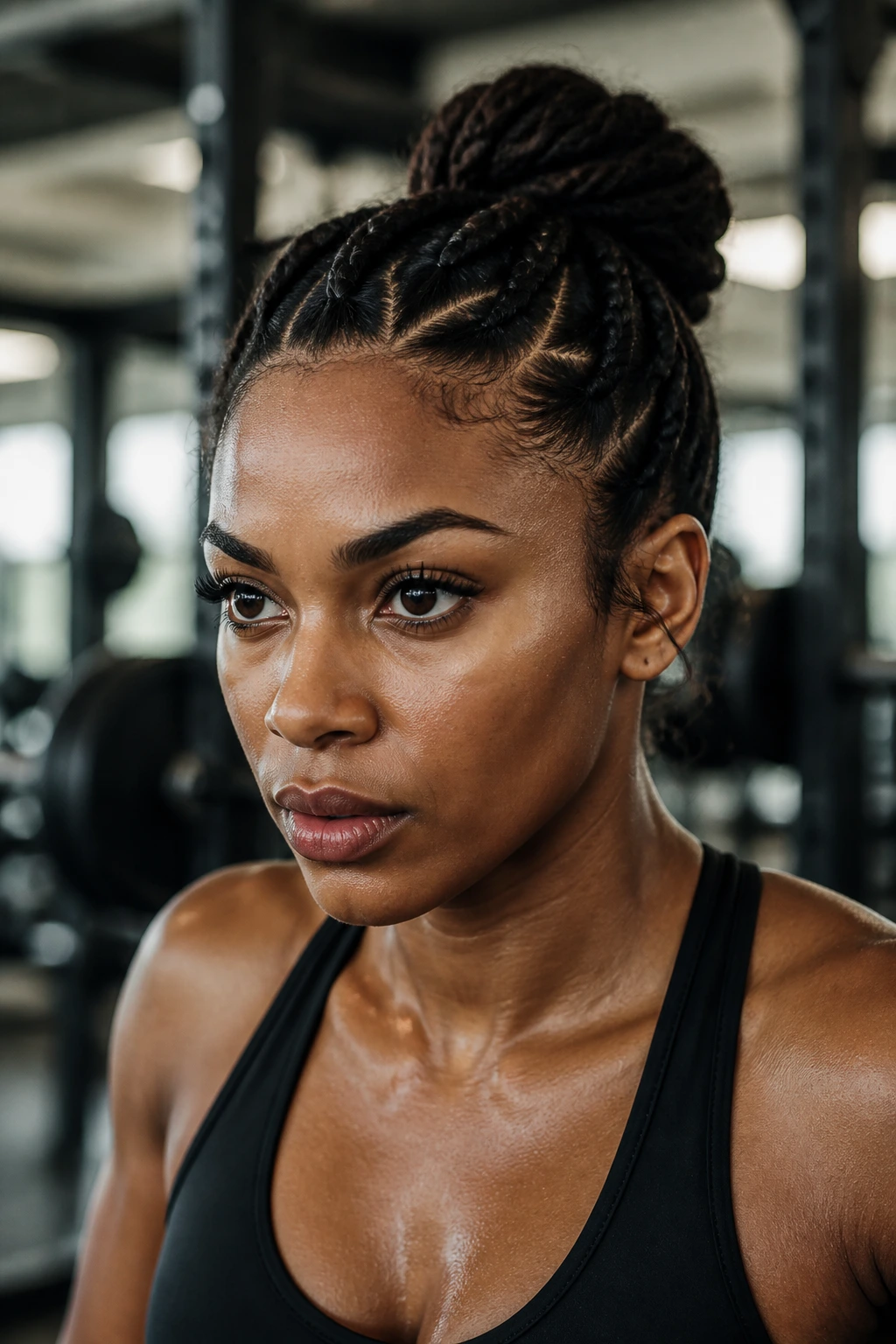
A great workout hairstyle is an investment in your focus, your performance, and your long-term hair health. By moving away from the lazy, high-tension ponytail and adopting smarter, sectioned styles, you protect your hairline from damage while keeping your mind entirely on your training.
Experiment with these styles to find the ones that work best for your hair length, texture, and workout routine. Remember to treat your hair with care before and after your sessions, using the right protective products and gentle, high-quality accessories. With a secure, comfortable hairstyle in place, you can step into the gym or onto the track with complete confidence, knowing your hair is locked down and ready to perform.